
The proposed new safety regulations for Uber and Lyft could lead to the ride-sharing services leaving Colorado.
- Jurek M. (Fundador)

- Dec 3, 2025
- 6 min read

Despite numerous amendments added by sponsors during the final two days of the legislative session to try to quell opposition, Colorado's largest ride-sharing company continues to threaten to leave the state. If Governor Jared Polis signs a bill to strengthen safety regulations in the industry.
House Bill 1291 was one of the most emotionally charged bills of the session, having been championed by Representative Jenny Willford, who was sexually assaulted by a Lyft driver last year. It subsequently sparked a wave of solidarity from women with similar experiences. It passed the House by a vote of 59 to 6, with the usually outspoken chamber remaining silent, and only faced difficulties in the Senate, where business leaders and Polis questioned the potential impact on transportation network companies.
However, when Bill 1291 was passed in the upper house on Wednesday morning, the last day of the session, it was a very different bill from the one Willford had introduced.
The focus on preventing people from impersonating drivers, as happened in this case, has virtually disappeared, as has the requirement for Uber, Lyft, and other companies to record every passenger trip. Now, the bill requires companies to deactivate drivers accused of assault, mandates semiannual background checks for drivers, and creates a private right of action for users to sue drivers and multinational corporations for incidents involving sexual assault, death, or injury.
“It would force Uber to shut down.”
Despite the series of amendments—10 approved by sponsors on Tuesday and Wednesday, plus a Republican-backed change to help the companies—none of the ride-hailing companies have backed down from their criticism of HB 1291, despite agreeing with its safety premise. Lyft stated that some last-minute changes worsened the bill, while Uber maintained its threat to cease operations in the state if required to comply with the proposal's most onerous provisions.

“We urge Governor Polis to veto HB25-1291, a bill developed behind closed doors and driven by the financial interests of billboard lawyers, not the needs of Colorado residents,” the company said in a statement. “If passed, this legislation would force Uber to shut down, depriving thousands of drivers of flexible income opportunities and cutting off a safe and reliable transportation option for hundreds of thousands of riders.”
Introducing the bill at a press conference on February 28, Willford made it clear that he wanted to prevent anyone else from going through what he did. He would do so by cracking down on hiring drivers with criminal records. The original bill mandated the use of the FBI’s background check system—a provision the companies challenged due to what they called flaws in the process compared to the checks they use—and required drivers to verify their identity on every trip and record the trip's content.
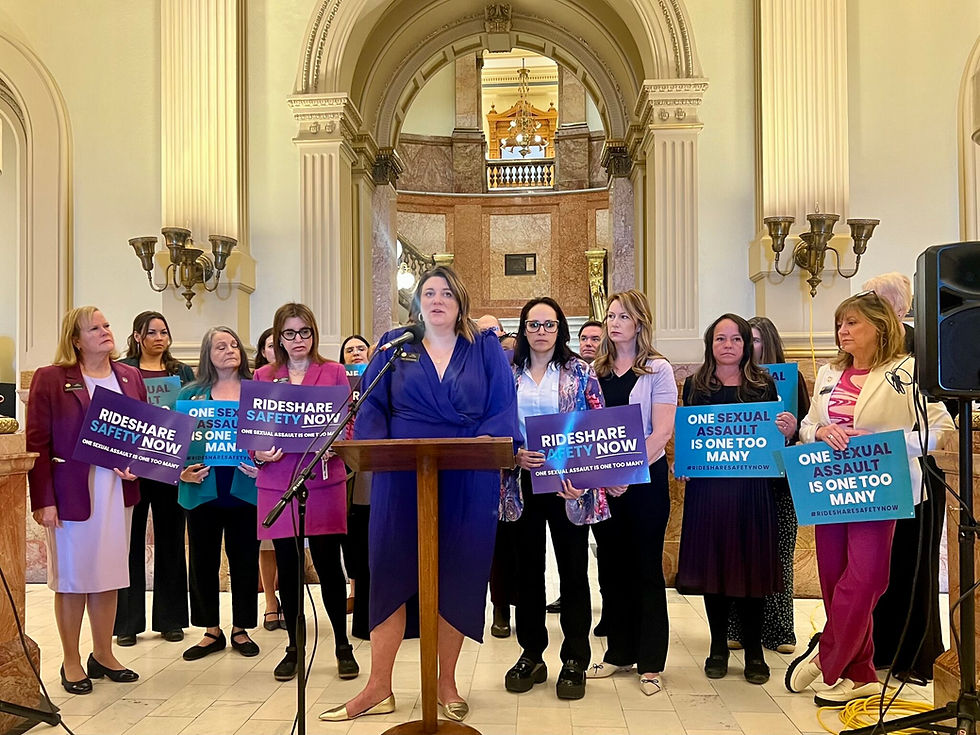
Colorado State Representative Jenny Willford explained her proposed legislation to strengthen safety requirements for ridesharing services during a press conference at the Capitol in February.
What's behind the ridesharing companies' opposition?
While Uber and Lyft claimed they also prioritize safety, they objected to the specific means of implementation. Both Uber and Lyft, as well as civil rights groups like the ACLU, pointed out that Colorado privacy laws limit the recording and retention of data without customer authorization. They argued that private legal action exposed them to liability even if drivers violated the multinational corporations' rules.
Uber and Lyft leaders offered different ways to achieve the same goals, such as charging those who impersonate registered drivers with second-degree felonies instead of requiring onerous verification for each trip, but sponsors rejected those ideas. By Wednesday, efforts to curb account sharing and driver impersonation had vanished from the bill, except for a provision requiring companies to create policies prohibiting such practices.
In what co-sponsor Sen. Jessie Danielson, D-Wheat Ridge, called the toughest concession, the bill would allow drivers and passengers to opt in to recording the ride, but would not require it. It no longer mandates that multinational companies provide drivers with the technology to enable video recording. Furthermore, it limits lawsuits to cases of sexual assault, death, and injury, rather than allowing them in cases where, for example, drivers violate policies that companies are required to develop prohibiting them from sharing food and water with passengers.
What the bill still requires of ridesharing companies
HB 1291 still mandates semi-annual criminal background checks and requires drivers to inform multinational companies within 48 hours of any new convictions or incidents that would prevent them from transporting passengers. It now requires the deactivation of drivers who are the subject of complaints and that companies allow passengers to view driver reviews, unless they are clearly biased. Furthermore, it requires companies to respond within seven business days to law enforcement requests for information about alleged assaults and other crimes.
Sponsors and supporters argued that the "multibillion-dollar companies," as they were often called, should no longer be able to ignore irregularities occurring within their vehicles and should be held accountable for strengthening security measures. Otherwise, they could face lawsuits and fines of up to $20,000, and would not be allowed to require customers, in cases of sexual assault or driver misconduct, to waive their right to a jury trial in favor of arbitration.
Colorado State Senators Jessie Danielson and Faith Winter debated their rideshare safety bill in the Senate on Tuesday.
"To these companies, I say: We no longer want you to get away with this. We no longer want you to intimidate and victims silence," declared Willford, who explained that the response to her sexual assault allegation was a refund and a promise not to be matched with that driver again. “One sexual assault is one too many, and their actions speak louder than words.”
But for these companies, the bill, while well-intentioned, is riddled with too many legal inconsistencies and unsustainable regulations to achieve its goals.
“Better Ways to Improve Safety in Colorado”
Testing before legislative committees, company leaders argued that the private right of action and the clause prohibiting arbitration violate federal arbitration law, apparently to generate more lawsuits for the lawyers who supported the bill. They also pointed out that the provisions requiring the swift deactivation of accused drivers are inconsistent with a TNC regulation bill passed last year. This requires companies to hear appeals from such drivers and give them a chance to return to the platform.
Aclu of Colorado officials briefed the Senate Business, Labor, and Technology Committee on April 22 that the large number of minor offenses that could disqualify potential drivers hinders employment for state residents with criminal records. Critics noted that while the bill now states that TNCs are not responsible for providing drivers with trip-recording equipment, the ACLU may require some investment in developing the regulations.
“While safety on our platform is paramount, the bill passed today in the Senate fails to address the fundamental flaws of the original version and, crucially, made the legislation worse. Multiple last-minute provisions were added without consideration of the long-term consequences they could have for both riders and drivers,” Lyft said Tuesday. “There are better ways to improve safety in Colorado, and we remain committed to working toward a more productive solution.” In an attempt to generate opposition to these provisions, Uber displayed a message to riders opening a request in Colorado, warning them that it would leave the state if the bill became law. Willford sharply criticized this tactic in the House of Representatives on Wednesday, stating that the company spent more time fighting the bill than collaborating with it to address safety.
The battle over a potential veto begins
"Instead of continuing our negotiations and good-faith discussions, they created a false ultimatum, a hostage situation," Willford stated. "I wonder if this bill would even have been necessary if ride-sharing companies had dedicated as many resources to security as they have to trying to eliminate it."
Sponsors also made a special appeal to Polis to sign the bill, expressing their fear that the Democratic governor will veto it. He did with a bill last month that sought to impose new regulations on social media companies to curb criminal activity on their platforms. Polis began his career as a disruptive tech executive and has opposed attempts to impose new regulations on tech companies, which he says could stifle innovation or subject them to standards no other company should have to meet.
“To our governor, who claims to want Colorado to be one of the safest states in the country… stop being so attached to a tech company that uses industry arguments against the very survivors who are begging you to see them,” Willford said. “Governor, I implore you to support the survivors, not just with words, but with the law. Sign this bill. Actions speak louder than words.”
Polis has until June 6 to sign or veto the bills passed in this legislative session.


Comments